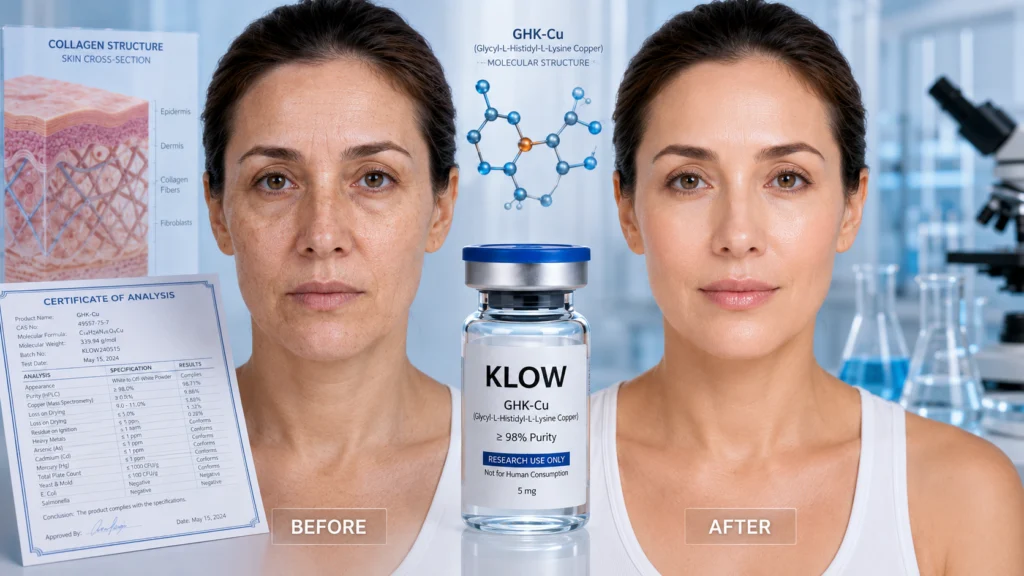
KLOW peptide skin research deserves a more focused discussion. Instead of presenting KLOW as a general anti-aging solution, this article explores how its four components connect with skin structure, repair, and visible dullness.
Therefore, Dull-looking skin can appear tired, uneven, rough, or less firm. Age can contribute to these changes. However, collagen loss, slower renewal, environmental stress, dryness, and inflammatory activity can also affect how the skin looks.
KLOW commonly combines:
- GHK-Cu
- BPC-157
- TB-500
- KPV
For example, Polygon Peptides lists KLOW 80mg as a blend containing 50mg GHK-Cu and 10mg each of BPC-157, TB-500, and KPV.
However, this article only provides educational and research information. It does not recommend human use or claim that KLOW treats skin aging.
Quick Summary
| Topic | Simple Explanation |
|---|---|
| Main content angle | Dull and aging-looking skin research |
| Main skin-focused component | GHK-Cu |
| Supporting components | BPC-157, TB-500, and KPV |
| Main research pathways | Collagen, repair, remodeling, and inflammatory signaling |
| Best related tool | KLOW component breakdown calculator |
| Important note | Research-only information |
Why Skin Can Look Dull
Dull-looking skin often reflects light poorly. As a result, the skin may appear flat, rough, tired, or uneven.
Several factors can affect this appearance. For example, collagen changes can reduce firmness, while dryness can make fine lines more noticeable. In addition, poor sleep, environmental exposure, and stress can affect skin quality.
Therefore, the most useful KLOW discussion should focus on research pathways rather than promises of younger-looking skin.
What Makes KLOW Different?
KLOW combines four peptides instead of relying on one compound.
A general KLOW peptide therapy overview discusses the blend across skin, recovery, inflammation, and gut-related research. Similarly, the EllieMD KLOW information page explains the separate role of each component.
However, GHK-Cu provides the strongest skin-focused angle. Meanwhile, the remaining peptides add broader repair and signaling context.
GHK-Cu and Skin Structure Research
GHK-Cu gives KLOW its clearest connection with skin research.
Researchers examine this copper-binding peptide because of its relationship with collagen, elastin, tissue remodeling, and extracellular matrix activity. Collagen supports skin structure, while elastin helps maintain flexibility.
Therefore, changes in these structural systems can affect how smooth and firm the skin appears. A PubMed review of GHK-Cu discusses its relationship with collagen, elastin, and dermal repair.
However, research into GHK-Cu does not prove that the complete KLOW blend reverses visible aging.
BPC-157 and the Repair Environment
Researchers mainly examine BPC-157 within tissue-repair models.
For example, studies have explored its relationship with fibroblast movement, cell survival, and repair signaling. Fibroblasts matter because they produce collagen and other structural materials.
Therefore, BPC-157 adds useful context to the wider skin-repair discussion. However, it should not appear as a direct treatment for dull or aging skin.
A PubMed study on BPC-157 and fibroblasts provides further research context.
TB-500 and Tissue Remodeling
Researchers connect TB-500 with thymosin beta-4 research involving cell migration and tissue repair.
Within KLOW, TB-500 supports the wider remodeling discussion. However, it does not provide the blend’s main skin-focused angle.
In addition, research into thymosin beta-4 and dermal healing helps explain why researchers associate this pathway with tissue recovery.
KPV and Inflammatory Signaling
KPV adds an inflammatory-signaling angle to KLOW research.
Skin stress and irritation can influence how even, clear, or refreshed the skin appears. Therefore, KPV adds a different research pathway beyond collagen and tissue remodeling.
However, researchers should not present KPV as a cure for redness, irritation, or skin conditions. Instead, a PubMed overview of melanocortin-related peptides offers broader context for this pathway.
Why KLOW Is More Than a GHK-Cu Blend
GHK-Cu provides the strongest skin-related research angle. However, the other three peptides expand the blend’s focus.
| Component | Research Role Within the Blend |
| GHK-Cu | Collagen and skin-remodeling pathways |
| BPC-157 | Fibroblast and tissue-repair research |
| TB-500 | Cell migration and remodeling research |
| KPV | Inflammatory-signaling research |
Therefore, KLOW works better as a multi-pathway research topic than as a simple anti-aging claim.
What Current KLOW Calculators Miss
Most KLOW calculators only show the total vial concentration.
For example, this existing KLOW dosage calculator converts the vial quantity and added liquid into concentration, volume, and U-100 syringe units.
However, it does not clearly show the amount of GHK-Cu, BPC-157, TB-500, and KPV within each selected research amount.
Therefore, a dedicated KLOW calculator on Peptide CostCalc could offer a more useful breakdown.
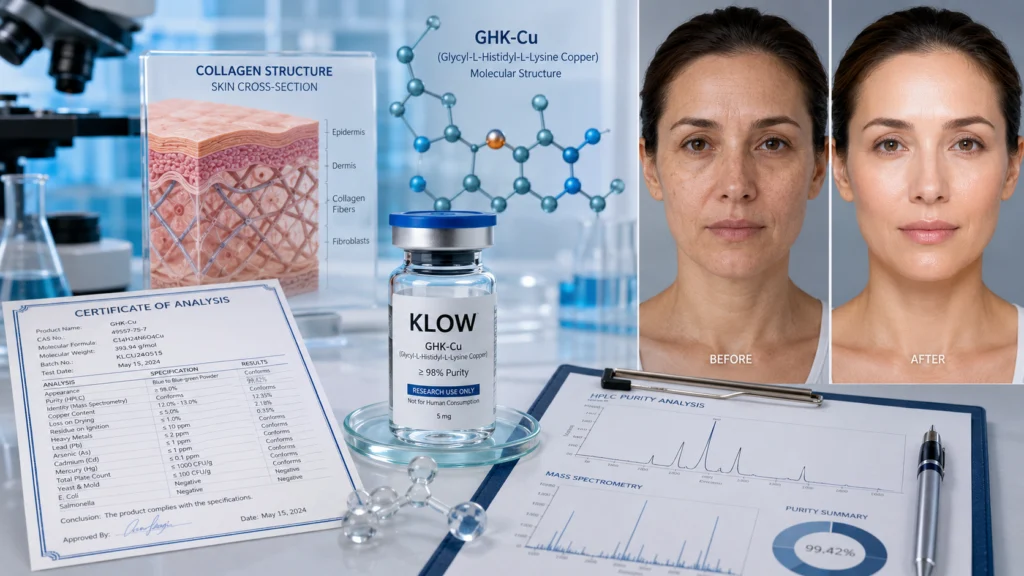
How a KLOW Blend Calculator Could Help
A KLOW Blend Calculator should show the total concentration and each component separately.
For example, an 80mg KLOW blend calculator could display:
- Total blend concentration
- GHK-Cu concentration
- BPC-157 concentration
- TB-500 concentration
- KPV concentration
- Each component’s percentage
- Selected research amount breakdown
- Draw volume in mL
- U-100 unit conversion
- Cost per total mg
- Cost per component
In addition, researchers could use the existing BAC Water Calculator and Peptide Purity Calculator for related calculations.
As a result, the new tool would provide more detail than a standard concentration calculator.
Important Research Limitations
Each KLOW component has a different amount and type of research behind it.
For example, much of the available evidence comes from laboratory, animal, preclinical, or limited human research. Therefore, evidence about one peptide does not automatically prove that the complete KLOW blend creates the same result.
More importantly, researchers should discuss pathways, blend composition, and mathematical calculations without promising treatments or guaranteed outcomes.
Frequently Asked Questions
Is KLOW mainly a skin peptide?
KLOW contains four peptides. However, GHK-Cu gives the blend its strongest skin-focused research angle.
Can KLOW reverse skin aging?
Current evidence does not support that claim. Therefore, researchers should discuss KLOW through collagen, remodeling, repair, and inflammatory pathways instead.
Why does KLOW relate to dull-looking skin research?
Dull-looking skin can reflect structural changes, dryness, stress, and inflammation. Because KLOW contains peptides connected with related pathways, it creates a useful research topic.
Why does KLOW need its own calculator?
A standard calculator only shows total concentration. In contrast, a KLOW-specific calculator can show the amount of every peptide inside the four-part blend.
Final Thoughts KLOW Peptide
Overall, KLOW peptide skin research becomes more useful when it avoids exaggerated anti-aging claims.
GHK-Cu provides the main skin-structure angle. Meanwhile, BPC-157 and TB-500 add wider repair and remodeling context. KPV also adds an inflammatory-signaling layer.
Therefore, a dedicated KLOW Blend Calculator would give PeptideCostCalc a stronger tool than existing basic concentration calculators. It could clearly explain the blend while calculating each component separately.