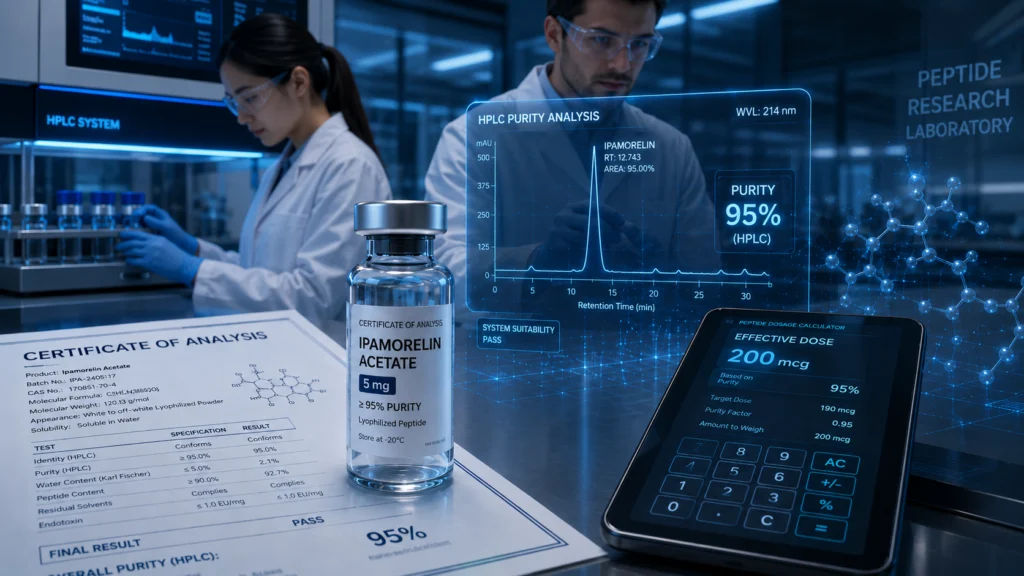
A peptide purity calculator helps show the real active amount inside a peptide vial. This matters because a vial labelled 5 mg does not always mean 5 mg of pure target peptide.
The CoA purity percentage tells how much of that vial is the actual peptide. The rest may include small impurities, related fragments, or other non-target material.
For simple research planning, this number matters a lot. It affects concentration, corrected amount, batch comparison, and real cost.
Why Peptide Purity Matters
A vial label shows total content. The purity percentage shows the active target content.
For example:
5 mg vial × 95% purity = 4.75 mg effective peptide
So, a 5 mg vial at 95% purity gives around 4.75 mg of target peptide.
That small gap may not look serious at first. However, it can affect repeated calculations across a full research plan.
It also matters when comparing batches. A 95% purity batch and an 88% purity batch are not equal, even if both vials say 5 mg.
Simple Purity Correction Formula
The basic formula is:
Corrected amount = target amount ÷ purity fraction
Example:
If the target amount is 200 mcg and the peptide purity is 95%, then:
200 ÷ 0.95 = 210.5 mcg
So, about 210.5 mcg total material is needed to estimate 200 mcg of target peptide.
This is the main reason a peptide purity calculator is useful. It removes guesswork and reduces manual math mistakes.
Use the internal tool here: open the calculator.
What Is a Good Purity Percentage?
For research-grade peptides, 98%+ is usually excellent.
Many reliable batches fall around 95–98%.
Below 90%, quality questions become more important.
Below 85%, the batch may need stronger review before serious research planning.
However, not every peptide is equally easy to make. Longer sequences and more complex structures can be harder to produce at very high purity. So, context matters.
Purity and Identity Are Different
Purity tells how much of the sample is the main compound. Identity tells whether that main compound is actually the correct peptide.
This is why quality documents often include both HPLC purity and mass spectrometry identity confirmation.
For more background, read this scientific overview of HPLC peptide analysis and purification. You can also review research on synthetic peptide quality evaluation.
A stronger CoA should show both purity and identity data.
Storage Can Also Affect Quality
Purity is not only about the dry vial. Storage after reconstitution can also affect quality.
Heat, light, poor handling, and long storage may reduce reliability. If a solution becomes cloudy or changes appearance, it should not be ignored.
CDC guidance notes that opened multi-dose vials are usually discarded within 28 days, unless the manufacturer gives a different date. More detail is available from the CDC injection safety guidance.
Quick Example: 95% vs 88%
A 5 mg vial at 95% purity gives about 4.75 mg effective peptide.
A 5 mg vial at 88% purity gives about 4.4 mg effective peptide.
That difference affects research planning and cost comparison.
A cheaper vial is not always cheaper if the effective peptide amount is lower.
 Final Thought
A peptide purity calculator makes peptide math easier. It helps adjust the labelled vial amount using the CoA purity percentage.
This gives a better estimate of the real effective peptide amount.
Use it here: open the calculator.
For better accuracy, compare purity data with CoA details, batch number, storage notes, HPLC results, and identity testing.