Syringe selection can sound like a small detail. However, in peptide research calculations, small measurement differences can change the final volume quickly. This is especially true when researchers work with small liquid volumes, IU markings, and reconstitution calculations.
That is why choosing the right syringe for peptide research matters before any calculation starts. The goal is simple: match the syringe size and markings to the research volume you need to measure.
This article is for research and educational purposes only. It is not medical advice and does not provide human-use, injection, clinical, or treatment guidance.
Why Syringe Choice Matters in Peptide Research
Peptide research often involves small calculated volumes. Because of that, clear markings and accurate volume reading are important.
A syringe that is too large can make small measurements harder to read. Meanwhile, a syringe with clear fine markings can make volume checks easier during research preparation.
For example, a small volume such as 0.05 ml is much easier to measure on a small-capacity syringe than on a large barrel syringe. Therefore, syringe size should match the approximate research volume being measured.
Understanding IU and mL Markings
Many insulin-style syringes use IU markings. These markings are commonly based on U-100 calibration, where:
100 IU = 1 ml
50 IU = 0.5 ml
25 IU = 0.25 ml
10 IU = 0.1 ml
This conversion is one of the most important parts of syringe-based peptide research calculations.
However, IU markings do not automatically tell you the peptide amount. They only show volume. The actual research amount depends on the concentration after reconstitution.
That is why researchers should calculate concentration first.
 Concentration Comes Before Syringe Marking
Before reading a syringe marking, you need to know the final concentration.
The basic idea is:
Peptide amount + reconstitution volume = concentration
For example, if a vial contains a known peptide amount and a known amount of BAC water is added, the final concentration can be calculated in mcg/ml or mg/ml.
After that, the needed research volume can be converted into an IU marking.
This is where a calculator helps because it reduces manual conversion mistakes.
You can use the Peptide CostCalc research calculators to check your numbers before measuring any research volume.
Common Syringe Sizes for Research Calculations
Different syringe sizes work better for different volume ranges.
0.3 ml syringe
A 0.3 ml syringe is useful when the calculated research volume is very small. Because the barrel is smaller, the markings are usually easier to read for low-volume measurements.
0.5 ml syringe
A 0.5 ml syringe is a practical middle option. It gives enough room for moderate research volumes while still keeping markings readable.
1 ml syringe
A 1 ml syringe works better when the calculated volume is higher. However, it may be less precise for very tiny volumes compared with smaller syringes.
The main rule is simple: avoid using an oversized syringe for a very small calculated volume.
Why Oversized Syringes Can Cause Problems
Oversized syringes can make small measurements harder to see.
For example, reading 0.05 ml on a 3 ml syringe is not ideal because the volume is too small compared with the barrel size. As a result, the final measurement may be less accurate.
A better approach is to match the syringe size to the expected volume range. This makes the markings easier to read and reduces avoidable calculation confusion.
Needle and Barrel Selection in Research Settings
For research workflows, the key point is not only the needle. The syringe barrel, markings, and volume capacity are just as important.
Researchers should check:
Syringe capacity
Marking clarity
IU or mL scale
Single-use labeling
Sterile packaging
Compatibility with the research workflow
Avoid selecting a syringe only because it is available. Instead, choose one that matches the calculated research volume.
Common Mistakes to Avoid
Several errors can happen when syringe markings and peptide concentration are not checked carefully.
Common mistakes include:
Confusing IU markings with peptide amount
Using a syringe that is too large for a small volume
Forgetting that concentration changes after reconstitution
Reading the wrong marking line
Not checking whether the syringe uses U-100 style markings
Doing manual math without verifying the result
The CDC also highlights the importance of single-use sterile needles and syringes in general safety guidance: CDC injection safety guidance.
Use a Calculator Before Reading the Syringe
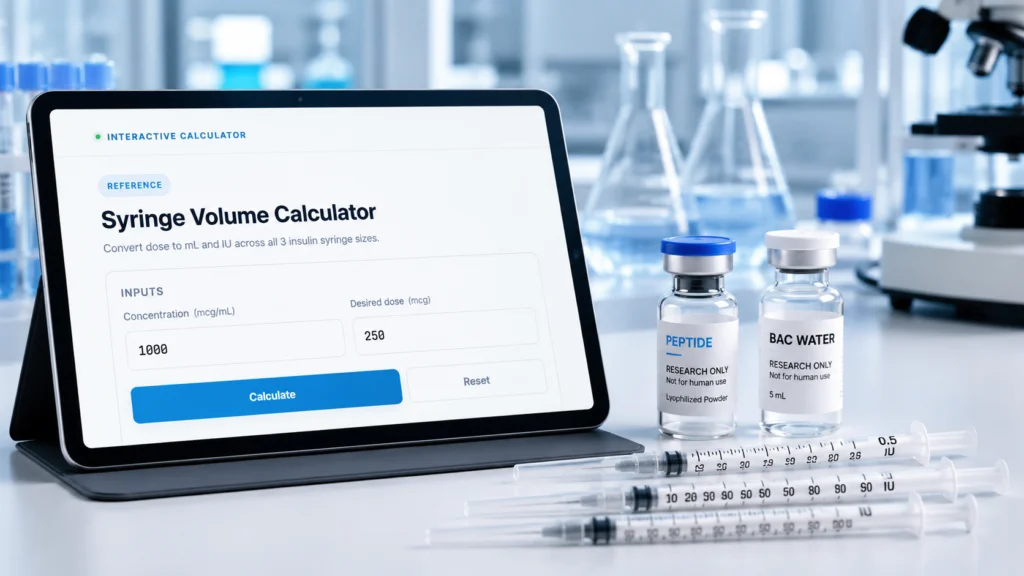
A peptide syringe volume calculator can make this process clearer.
Instead of manually converting concentration, volume, and IU markings, the calculator can show the expected syringe marking based on the research inputs.
This is especially useful when comparing different vial sizes, reconstitution volumes, or research concentrations.
For a faster workflow, open the Peptide CostCalc calculator tools and check the syringe volume before starting your research calculation.
FAQs About Choosing a Syringe for Peptide Research
What is the best syringe for peptide research?
The best syringe for peptide research depends on the calculated liquid volume. For very small research volumes, a 0.3 ml or 0.5 ml syringe is usually easier to read than a larger syringe. For higher volumes, a 1 ml syringe may be more practical.
What does IU mean on a syringe?
IU means International Units. On many U-100 insulin-style syringes, 100 IU equals 1 ml. This means 50 IU equals 0.5 ml, 25 IU equals 0.25 ml, and 10 IU equals 0.1 ml. However, IU markings show volume, not the peptide amount.
Is IU the same as mcg?
No. IU and mcg are not the same. IU usually refers to the syringe marking or unit scale, while mcg means micrograms. To connect both, you need to know the final concentration after reconstitution.
Why does syringe size matter in peptide research?
Syringe size matters because small volumes are harder to measure on large syringes. A syringe that matches the expected research volume can make the markings easier to read and may reduce calculation mistakes.
How do you convert ml to IU on a U-100 syringe?
On a U-100 syringe, 1 ml equals 100 IU. So, 0.5 ml equals 50 IU, 0.25 ml equals 25 IU, and 0.1 ml equals 10 IU. A calculator can help confirm the correct syringe marking before measuring.
Why should researchers use a syringe calculator?
A syringe calculator helps convert vial amount, reconstitution volume, concentration, and target research amount into a clearer syringe marking. This reduces manual math and makes the research workflow easier to check.
Can one syringe be reused in research settings?
No. Syringes and needles should be treated as single-use items. Reuse can affect sterility, accuracy, and general lab safety. Always follow proper research handling and disposal standards.
What is the safest way to avoid syringe measurement errors?
The safest approach is to calculate first, confirm the concentration, use the right syringe size, read the markings carefully, and verify the final volume before continuing the research workflow.
Use a calculator, confirm the concentration, and choose a syringe size that fits the expected research volume.