Quick Answer
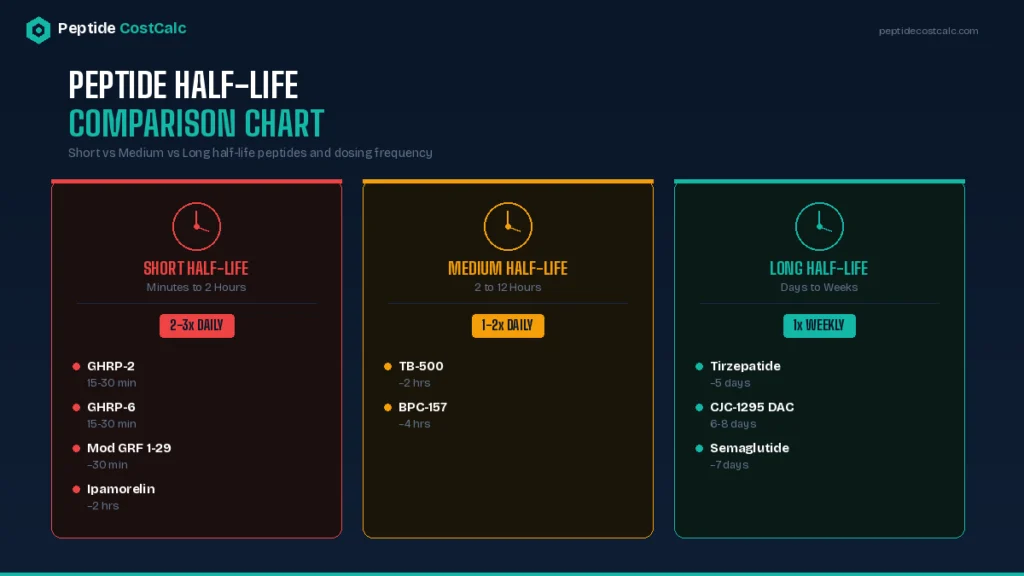
Peptide half-life is the time it takes for a compound’s concentration to drop to 50% of its peak level. It directly determines how often you need to dose. Short-half-life peptides like GHRP-2 (15–30 min) require multiple daily doses. Medium-half-life peptides like BPC-157 (4 hours) require twice-daily dosing. Long-half-life peptides, such as semaglutide (7 days), require only once-weekly administration. Use a peptide half-life calculator to plan your exact dosing intervals.
Key Takeaways
- Half-life determines dosing frequency — not total dose, but when you administer it
- Steady state takes 4–5 half-lives of repeated dosing to reach
- Washout after stopping takes another 4–5 half-lives for full clearance
- Dosing too frequently causes accumulation; too infrequently causes coverage gaps
- A half-life calculator removes the guesswork from interval planning
What Peptide Half-Life Means in Plain Language
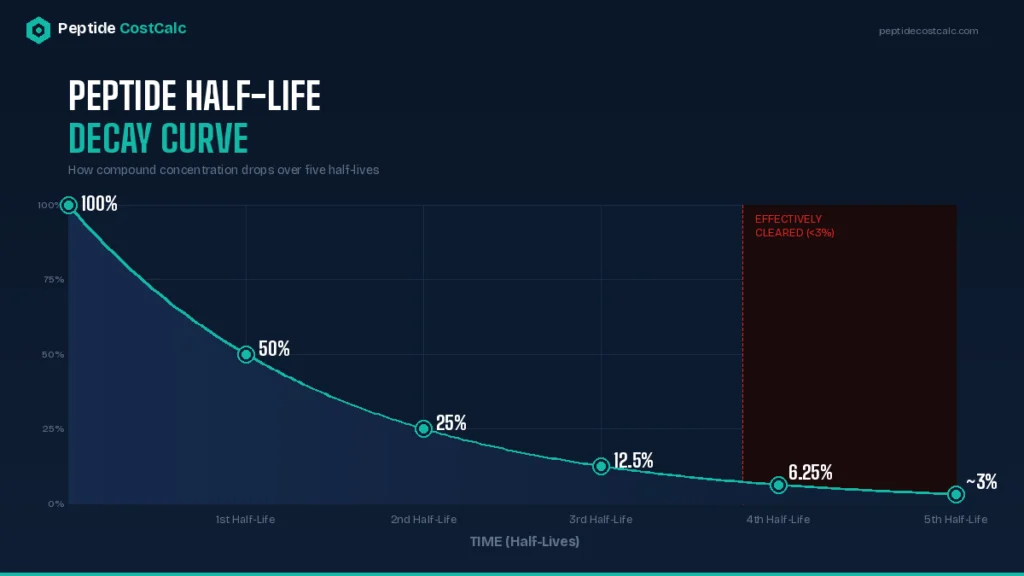
Peptide half-life is the time it takes for the concentration in the bloodstream to fall to half its peak level. Peptide half-life is the time it takes for the concentration in the bloodstream to fall to half its peak level. One half-life leaves 50% remaining. By the second, only 25% is left After three, about 12.5%. After roughly five half-lives, the compound has cleared to below 3% of the original level, which pharmacokinetics research considers effectively cleared.
This matters because most peptides need to stay at or above a minimum effective concentration to produce the research effect you are studying. Fall below that threshold, and the compound is not doing much. Exceed it significantly, and you risk side effects or receptor downregulation.
Half-Life vs Duration of Action – They Are Not the Same
Half-life tells you how long a compound stays in the bloodstream at meaningful levels. Duration of action is different — a compound can have measurable biological effects even after its circulating concentration has dropped significantly.
For example, TB-500 has a circulating half-life of roughly 2 hours, but its tissue-level effects can persist for days because of how it interacts with actin at the cellular level. Understanding this distinction prevents the mistake of overdosing based on blood levels alone.
Why Peptide Half-Life Matters for Research Dosing
Two researchers can use the same compound, the same total daily dose, and get completely different results. The difference is timing. Half-life is the reason.
Too Frequent: The Accumulation Problem
Dosing more often than necessary causes compound levels to stack. Each new dose adds on top of what remains from the last one. Over time, concentrations climb higher than intended. This increases the risk of receptor desensitization — the receptors effectively stop responding because they are constantly stimulated.
Understanding how peptide purity affects your effective dose makes this even more important. If your compound is only 95% pure, the actual active amount is already lower than expected — and stacking imprecise doses compounds the problem.
Too Infrequent: The Coverage Gap
If you space doses too far apart, levels drop below the effective threshold between administrations. Each dose basically starts from scratch instead of building on the previous one. The compound never reaches steady state, and results become inconsistent.
The goal is finding the sweet spot — maintaining concentrations within the effective range without excessive peaks or deep troughs. Half-life is the number that makes this possible.
Short Half-Life Peptides: Frequent Dosing Required
These compounds clear from the system within minutes to a couple of hours. They demand the most disciplined dosing schedules.
GHRP-2 and GHRP-6 – 15 to 30 Minutes
These are among the shortest half-life peptides in common research use. According to PubChem compound data, both compounds are rapidly metabolized, with a single daily dose effectively gone within two hours. Protocols typically involve two to three daily administrations.
CJC-1295 Without DAC (Mod GRF 1-29) – 30 Minutes
Without the Drug Affinity Complex modification, this compound requires multiple daily administrations similar to GHRP peptides. It is commonly stacked with GHRP-2 or GHRP-6 for combined GH pulse effects. Timing both compounds together maximizes the synergistic growth hormone release.
Why Food Timing Matters for Short Half-Life Compounds
When a peptide clears in under an hour, even small variables like meal timing can make a measurable difference. Insulin spikes from food can interfere with GH-releasing peptides specifically. Consuming a large carbohydrate or fat-rich meal before administration can blunt the research response because the body is already in a different hormonal state. Most protocols recommend dosing on an empty stomach or at least 30 minutes before eating.
This is less of a concern for peptides like BPC-157, where the mechanism of action is different.
Medium Half-Life Peptides: Twice Daily Dosing
These compounds give more flexibility than the ultra-short peptides but still require at least twice daily administration for consistent coverage.
Ipamorelin – Approximately 2 Hours
Longer than GHRP compounds but still short enough to need multiple daily doses for sustained effects. Ipamorelin is often paired with Mod GRF 1-29 in research protocols. Its cleaner GH release profile with fewer side effects makes it popular despite the dosing frequency requirement.
TB-500 (Thymosin Beta-4) – 2 Hours Circulating
Despite the short circulating half-life, TB-500 has prolonged tissue-level activity due to its mechanism of action on actin regulation. Most research protocols use twice-weekly administration during a loading phase, followed by less frequent maintenance dosing. This is one of the clearest examples of why half-life and duration of action are not the same thing.
BPC-157 – Approximately 4 Hours
The most commonly researched healing peptide has a half-life that supports twice-daily administration. Splitting the total daily dose into two equal injections roughly 12 hours apart helps maintain more consistent tissue levels.
When working with BPC-157 reconstitution, choosing the right solvent matters. Our BAC water vs sterile water comparison explains which to use and why. Once you have chosen your solvent, the BAC water calculator gives you the exact volume needed for your target concentration.
Researchers running BPC-157 and TB-500 together can use the BPC-157 TB-500 blend calculator to plan both compounds in a single protocol.
Long Half-Life Peptides: Weekly Dosing
These compounds were engineered for convenience. Their extended half-lives allow once-weekly or even less frequent dosing.
Tirzepatide – Approximately 5 Days
A dual GIP/GLP-1 receptor agonist with a half-life that supports once-weekly administration. Slightly shorter half-life than semaglutide means steady state is reached a few days earlier. The semaglutide and tirzepatide dose calculator helps plan accurate dosing intervals for both compounds. For a deeper comparison of these two compounds, read our semaglutide vs tirzepatide research guide.
CJC-1295 With DAC – 6 to 8 Days
The Drug Affinity Complex modification dramatically extends the half-life compared to the non-DAC version. This allows once or twice weekly dosing and produces a sustained elevation of growth hormone levels rather than the sharp pulse seen with non-DAC versions.
Semaglutide – Approximately 7 Days
Engineered specifically for once-weekly administration. According to the FDA prescribing information, semaglutide reaches steady state in approximately 4–5 weeks of weekly dosing. This is why most protocols include a gradual dose-escalation phase during the first month.
 Complete Peptide Half-Life Chart (2026 Reference)
| Compound Half-Life, Typical Dosing Frequency | cy, Time | to Steady State | |
|---|---|---|---|
| GHRP-2 | 15–30 min | 2–3x daily | 2–3 hours |
| GHRP-6 | 15–30 min | 2–3x daily | 2–3 hours |
| Mod GRF 1-29 | ~30 min | 2–3x daily | 2–3 hours |
| Ipamorelin | ~2 hours | 2–3x daily | 10–12 hours |
| TB-500 | ~2 hours | 2x weekly | 10–12 hours |
| BPC-157 | ~4 hours | 2x daily | 20–24 hours |
| Tirzepatide | ~5 days | 1x weekly | 25–30 days |
| CJC-1295 (DAC) | 6–8 days | 1–2x weekly | 30–40 days |
| Semaglutide | ~7 days | 1x weekly | 35 days |
These values are approximate. Always verify against compound-specific published literature before finalizing any protocol.
Steady State: The Concept Most Researchers Miss
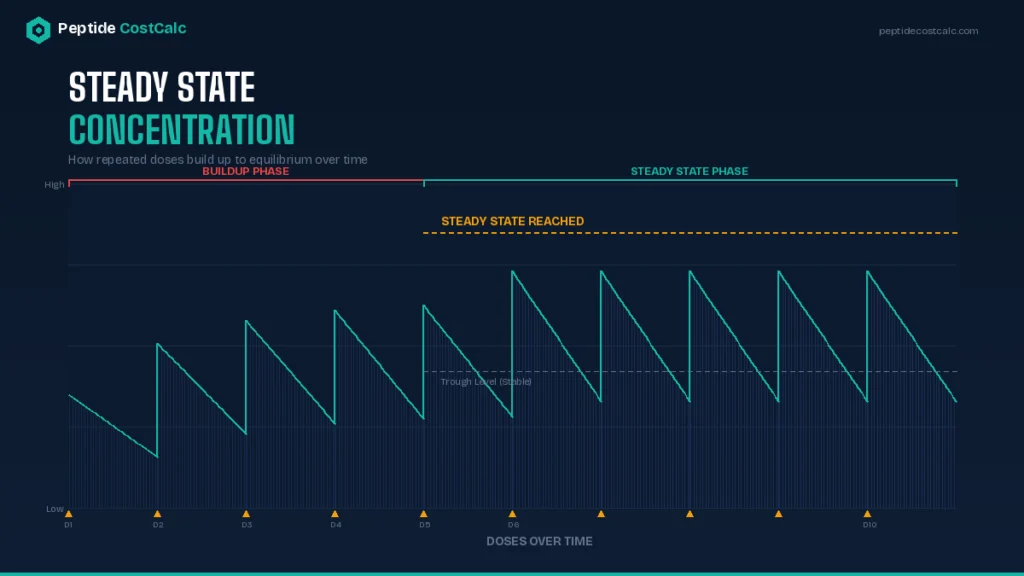
Here is what most basic half-life explanations skip entirely. When you administer a compound repeatedly, each dose adds to what remains from the previous dose. Steady state is the point at which the amount being eliminated between doses equals the amount being added with each new dose.
This typically occurs after 4–5 half-lives worth of repeated dosing.
How to Calculate When Steady State Is Reached
The formula is simple: multiply the half-life by 5.
- BPC-157 (4-hour half-life) dosed twice daily → steady state in ~20 hours
- Semaglutide (7-day half-life) dosed weekly → steady state in ~35 days
This is why effects from long half-life compounds seem to “ramp up” over weeks. The compound is genuinely building in the system.
Why Does Escalation Exist
GLP-1 research protocols almost always include a dose-escalation phase during the first 4–6 weeks. This is not only for tolerability. The effective concentration is still climbing during this period because the steady state has not been reached. Starting at the full dose before steady state means the eventual peak concentration will be significantly higher than intended.
 Washout Periods: How Long Until Full Clearance
When a research protocol ends, the compound does not disappear immediately. Full clearance takes approximately 4–5 half-lives after the last dose. Researchers planning follow-up protocols or compound switches need to account for this residual activity.
| Compound Half-Life Approximate | Full Washout | |
|---|---|---|
| BPC-157 | ~4 hours | ~20 hours |
| TB-500 | ~2 hours | ~10 hours |
| Ipamorelin | ~2 hours | ~10 hours |
| Tirzepatide | ~5 days | ~25 days |
| Semaglutide | ~7 days | ~5 weeks |
Starting a new compound before the previous one has cleared can create unpredictable interactions. Always allow full washout between different protocols.
Using a Half-Life Calculator for Dosing Intervals
Working out the optimal dosing interval by hand involves logarithmic calculations that are easy to get wrong. The peptide half-life calculator takes the compound’s half-life value and your target dosing interval and tells you what percentage remains at the time of the next dose.
When Manual Calculation Goes Wrong
The most common mistake is assuming linear decay. Half-life decay is exponential — the rate of decline slows as concentration decreases. A calculator handles this automatically, while manual estimation tends to overestimate how quickly a compound clears.
As a general rule for dosing frequency:
- Half-lives under 2 hours → multiple daily administrations
- Half-lives of 4–12 hours → once or twice daily
- Half-lives above 24 hours → less frequent, and excessive frequency causes unnecessary accumulation
For converting your calculated dose into actual syringe measurements, the peptide dosage calculator handles the mcg-to-IU conversion automatically.
Common Dosing Mistakes to Avoid
Mistake 1 – Ignoring Half-Life When Choosing Frequency
Choosing dosing frequency based on convenience rather than pharmacokinetics leads to either accumulation or coverage gaps. Always check the half-life before setting a schedule.
Mistake 2 – Not Accounting for Steady State Buildup
Expecting full effects from the first dose of a long half-life compound is unrealistic. It takes 4–5 half-lives to reach peak effectiveness. Be patient during the buildup phase.
Mistake 3 – Skipping Washout Between Protocols
Jumping from one compound to another without allowing adequate clearance time creates overlapping effects. Calculate washout using the half-life chart above before switching compounds.
Best Practices for Peptide Dosing Timing
- Always check the published half-life before designing any protocol
- Split daily doses evenly across waking hours for short half-life compounds
- Allow 4–5 half-lives for both steady state buildup and washout clearance
- Time GH-releasing peptides around fasting windows to avoid insulin interference
- Keep dosing times consistent from day to day for reliable results
- Use a syringe volume calculator to ensure accurate draw volumes at each dose
- Record dosing times alongside research observations to identify timing-related patterns
- When reading a supplier’s compound data, know how to read a Certificate of Analysis to verify the purity and identity before starting any protocol
Final Verdict
Peptide half-life is not just a pharmacokinetic number to note and forget. It determines your dosing schedule, shapes how long it takes to see effects, controls when steady state is reached, and tells you how long the research window actually lasts after the last administration.
Spend a few minutes calculating it properly before designing any protocol, and you will avoid one of the most common sources of inconsistency in peptide research.
Calculate Your Dosing Interval
Use the free peptide half-life calculator to map out active compound levels and find the optimal dosing interval for any research compound.
Frequently Asked Questions
What is the half-life of BPC-157?
BPC-157 has an estimated half-life of approximately 4 hours. This means twice-daily administration — roughly every 12 hours — is the most common research protocol for maintaining consistent tissue levels throughout the day.
How long does semaglutide stay in your system?
Semaglutide has a half-life of approximately 7 days. After the last dose, it takes about 5 weeks (35 days) for the compound to fully clear from the system. This extended washout period is important to account for when planning follow-up research protocols.
Does the injection site affect peptide half-life?
The injection site affects the absorption rate, not the elimination half-life. Subcutaneous injections absorb more slowly than intramuscular injections, which can slightly alter when the peak concentration is reached. However, the rate at which the body eliminates the compound remains the same regardless of the injection method. For help choosing the right syringe type, check our syringe selection guide.
How do I calculate when the steady state is reached?
Multiply the half-life by 5. For BPC-157 with a 4-hour half-life, steady state arrives in approximately 20 hours of consistent dosing. For semaglutide with a 7-day half-life, steady state takes roughly 35 days of weekly administration.
Can I use a calculator instead of doing the math manually?
Yes. The free peptide half-life calculator automates the logarithmic math and shows you exactly what percentage of the compound remains at any point between doses. This is faster and more accurate than manual calculation.
All content is for educational and informational reference only. Consult a qualified professional before making any decisions based on information presented here.
Last Updated: June 2026