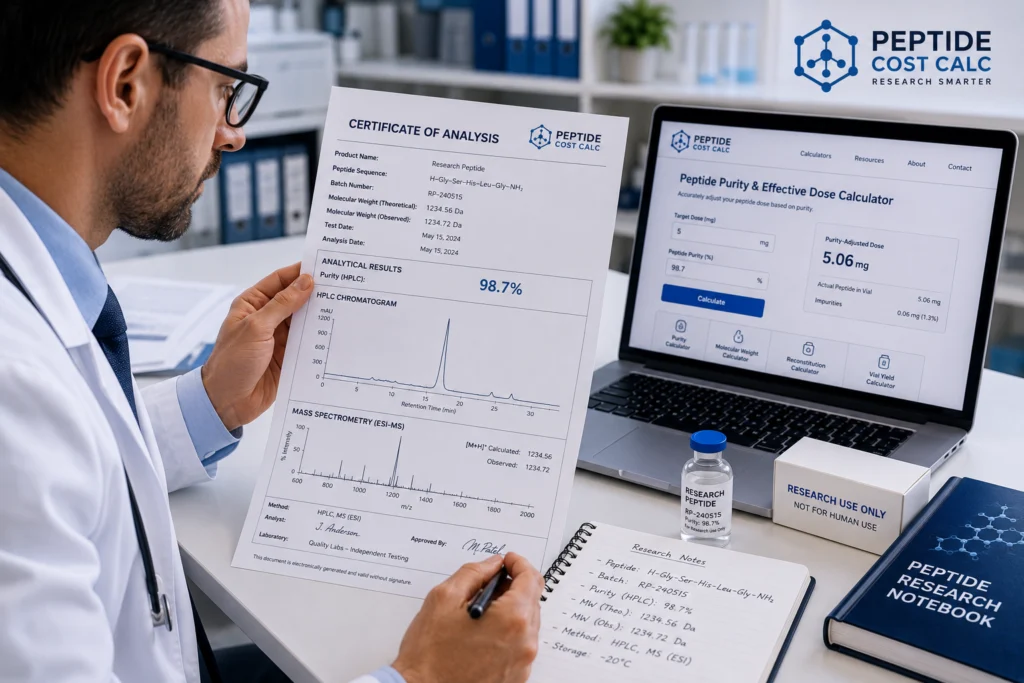
A peptide certificate of analysis is the document that tells you what is actually in a research peptide vial.
It is not just a form. It is the quality record that helps confirm peptide identity, purity, molecular weight, batch number, and testing method.
A good supplier should provide a CoA for every batch. Also, the CoA should match the exact vial or order record you received.
Without a certificate of analysis, you are mostly trusting the label. However, with a proper CoA, you can check the lab data before you rely on the material.
What a Peptide Certificate of Analysis Contains
A peptide certificate of analysis should include the basic details needed to verify the batch.
Look for:
- Peptide name
- Amino acid sequence
- Batch number
- Testing date
- Purity percentage
- Molecular weight
- HPLC chromatogram
- Mass spectrometry result
- Testing lab details
Each item has a purpose.
The peptide name tells you what the product claims to be. The batch number links the report to the vial. Meanwhile, the purity percentage and test data help show the quality of the sample.
If the CoA only shows a purity number, it is weak. A useful peptide CoA should show the result and the proof behind it.
Why a Peptide CoA Should Be Batch-Specific
A peptide CoA should match one exact batch.
This matters because peptide quality can change from batch to batch. Even if the product name is the same, purity and impurities may not be the same.
Therefore, always compare the batch number on the CoA with the batch number on your vial, label, or order record.
If the numbers do not match, the CoA does not prove the quality of your batch.
Also, check the testing date. A very old CoA may belong to old stock or a previous production run.
Why Third-Party CoA Testing Matters
Third-party testing is better because the lab is separate from the supplier.
A supplier can test its own product. However, that creates a conflict of interest because the supplier benefits from good-looking results.
This does not mean every in-house report is false. Still, an independent lab report gives more trust.
For serious research work, the supplier should be able to answer simple questions about HPLC, mass spectrometry, purity, and batch numbers.
If the supplier avoids these questions, that is a warning sign.
HPLC Purity in a Peptide Certificate of Analysis
Purity is usually the first number people check on a peptide certificate of analysis.
It is shown as a percentage, such as 95%, 98%, or 99%.
This number usually comes from HPLC, which stands for high-performance liquid chromatography. HPLC is a lab method used to separate and measure compounds in a sample. You can read a simple HPLC overview from Thermo Fisher here: thermofisher
For example, a 98% purity result means the main peptide peak makes up about 98% of the detected sample area.
The other 2% may include peptide fragments, incomplete synthesis products, or other impurities.
However, purity does not prove the peptide identity by itself. It only shows how clean the sample looks in that test.
Why the HPLC Chromatogram Matters
A good CoA should include the actual HPLC chromatogram.
This is the graph that shows the peaks found during testing.
The target peptide should appear as one clear main peak. Small extra peaks may appear, but they should not be close to the main peak in size.
On the other hand, several large peaks can be a problem. They may suggest impurities, poor synthesis, degradation, or a mixed sample.
As a result, the graph is often more useful than the purity number alone.
Mass Spectrometry on a Peptide Certificate of Analysis
HPLC tells you how clean the sample looks. However, it does not fully prove that the main compound is the correct peptide.
Mass spectrometry helps with identity checking.
Mass spectrometry, often called MS, measures the mass-to-charge ratio of molecules. This can help confirm the molecular weight of the detected compound. You can read Broad Institute’s simple explanation here: what is mass spectrometry ?
A strong peptide certificate of analysis should include both HPLC and MS data.
HPLC helps answer: how pure does the sample look?
MS helps answer: does the compound match the expected identity?
Together, they give a much better picture.
Molecular Weight on a Peptide CoA
Every peptide has an expected molecular weight based on its amino acid sequence.
The CoA should show the observed molecular weight from mass spectrometry. This number should be close to the expected value.
PubChem defines molecular weight as the sum of the atomic weights in a compound. You can view its glossary here: pubchem
A small difference may be normal. However, a large difference can be a serious red flag.
It may suggest:
- Wrong sequence
- Missing modification
- Unexpected modification
- Degradation
- Incorrect product identity
You can also use the Molecular Weight Calculator here: molecular weight calculator
This helps you compare sequence-based values with the CoA number.
Peptide Certificate of Analysis Red Flags
Some CoAs look clean at first. However, they may still miss important details.
Watch for these red flags:
- No batch number
- No testing date
- No HPLC chromatogram
- No mass spectrometry result
- No lab name
- Only a purity percentage
- Blurry or edited-looking document
- Batch number does not match the vial
- Same CoA used for many products
- Supplier avoids technical questions
One weak point may not prove the product is poor. However, several weak points together should make you careful.
What to Do If a Peptide CoA Looks Wrong ?
If the purity is lower than claimed, ask the supplier for clarification.
If mass spectrometry data is missing, ask whether identity testing was done.
If the chromatogram shows several strong peaks, ask what those peaks mean.
Also, if the batch number does not match, request the correct batch-specific CoA.
A reliable supplier should answer clearly. They should also provide the right document if the wrong one was shared.
However, if the supplier gives vague answers, it is better to be cautious.
Correct Your Research Amount for Purity
Once you have the purity percentage from your CoA, you can use it in your research calculations.
For example, a 10 mg vial at 98% purity contains about 9.8 mg of target compound by purity estimate.
Meanwhile, a 10 mg vial at 90% purity contains about 9 mg of target compound.
That difference matters because the same stated mass does not always mean the same target amount.
Use the Peptide Purity Calculator here: peptide tools
Enter the target amount and CoA purity. Then, the calculator estimates the purity-adjusted figure.
You can also browse all peptide calculators here: peptide cost calc
Useful tools include:
- Peptide Purity Calculator
- Molecular Weight Calculator
- BAC Water Calculator
- Reconstitution Volume Optimizer
- Vial Yield Calculator
These tools are for educational research math only. They do not replace supplier documents, lab testing, or professional review.