How to Convert mg to Units on a Syringe
One of the most common mix-ups in handling injectables is treating milligrams and syringe units as if they were the same thing. They are not, and the gap between them is where dosing errors creep in. Learning how to convert mg to units on a syringe takes one extra piece of information and one short formula, and once you have both it becomes routine.
This guide explains why the conversion needs a concentration, how the maths works, and gives you a quick reference table to check against.
Quick Answer
To convert milligrams to units, you first need the solution’s concentration in mg per mL. Divide the dose in mg by that concentration to get the volume in mL, then multiply by 100, because a U-100 insulin syringe reads 100 units to the millilitre. So units = (mg divided by concentration) times 100.
Syringe Volume Calculator (mg to Units) Convert a dose in mg or mcg into mL and units, and compare the draw on 0.3, 0.5 and 1 mL insulin syringes.Why mg Does Not Convert Directly to Units
Here is the point everything else depends on: a milligram is a weight, and a unit on an insulin syringe is a volume. You cannot turn one into the other without knowing how concentrated the liquid is. The same 1 mg sits in a large volume if the solution is dilute and a small volume if it is concentrated, so the number of units is different in each case.
That is why there is no fixed answer to “how many units is 1 mg”. The honest answer is always another question: 1 mg in what concentration? Get the concentration first, and the rest is arithmetic.
What “Units” Mean on an Insulin Syringe
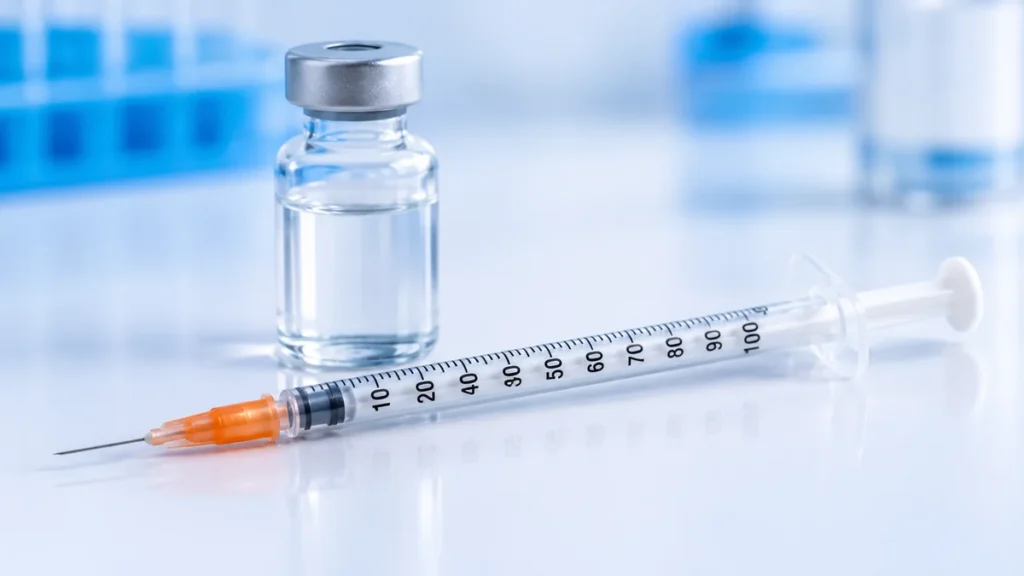
A standard insulin syringe is a U-100 syringe. That marking tells you the scale: 100 units are equal to 1 mL. From there, every other point follows. Half a millilitre is 50 units, a tenth of a millilitre is 10 units, and a single unit is 0.01 mL.
It is worth being clear about one thing. On a peptide or research vial, the units printed on the barrel are simply volume marks, not a measure of how much compound you are drawing. They tell you how far to pull the plunger, nothing more. The actual amount of compound in that draw still depends on the concentration of the solution.
The Formula
Put together, the conversion is two steps folded into one line.
units = (dose in mg divided by concentration in mg per mL) times 100
The middle of that formula, dose divided by concentration, gives you the volume in millilitres. Multiplying by 100 turns millilitres into units on the U-100 scale. If you ever want the volume on its own, just stop before the final step.
A Worked Example
Say your solution is 5 mg per mL and you want a 2.5 mg dose.
Divide the dose by the concentration: 2.5 divided by 5 equals 0.5 mL.
Multiply by 100: 0.5 times 100 equals 50 units.
So you draw to the 50 unit mark. Change the concentration and the answer changes with it. If the same 2.5 mg sat in a 10 mg per mL solution, the volume would be 0.25 mL, which is 25 units. Same dose, different concentration, different mark on the syringe.
Quick Reference Table
These are worked with the same formula, so you can see how concentration drives the result.
| Concentration | Dose | Volume | Units on a U-100 syringe |
|---|---|---|---|
| 2 mg/mL | 1 mg | 0.5 mL | 50 units |
| 5 mg/mL | 1 mg | 0.2 mL | 20 units |
| 5 mg/mL | 2.5 mg | 0.5 mL | 50 units |
| 10 mg/mL | 2.5 mg | 0.25 mL | 25 units |
| 10 mg/mL | 5 mg | 0.5 mL | 50 units |
Read across any row and the pattern is the same: the dose and the concentration together decide the units, never the dose alone.
Common Mistakes
The first mistake is the one this whole guide is built around: assuming a milligram maps to a fixed number of units. It never does without a concentration.
The second is confusing the units on an insulin syringe with the standardised units used for insulin itself. For insulin, a unit is a defined amount of the drug. For almost everything else drawn into the same syringe, a unit is just 0.01 mL of volume. Treating the two the same way is how people end up drawing the wrong amount.
The third is forgetting to work out the concentration after reconstitution. If you add water to a powder, the concentration is the compound amount divided by the water volume, and that figure feeds straight into this conversion.
Letting the Calculator Do It
Once you know the concentration, the sum is quick, but it is also easy to slip a decimal place with a syringe in your other hand. Our mg to units converter does both steps for you: enter the dose and the concentration and it returns the exact unit mark. If you are still at the mixing stage, our step-by-step guide on how to reconstitute peptides and our complete guide to bacteriostatic water for peptides work out the concentration first, and this conversion picks up from there.
The Bottom Line
Converting mg to units on a syringe is never about the milligrams alone. Find the concentration, divide the dose by it to get the volume, and multiply by 100 for a U-100 syringe. Keep the insulin-unit and volume-unit meanings separate, check your result against a reference row, and let a calculator carry the decimals so the mark you draw to is the one you meant.
Frequently Asked Questions
How do you convert mg to units on a syringe?
Divide the dose in mg by the solution’s concentration in mg per mL to get the volume in mL, then multiply by 100 for a U-100 insulin syringe. Units equal (mg divided by concentration) times 100.
How many units is 1 mg?
It depends entirely on the concentration. At 5 mg per mL, 1 mg is 0.2 mL, which is 20 units. At 2 mg per mL, the same 1 mg is 50 units.
How many units are in 1 mL on an insulin syringe?
On a U-100 insulin syringe, 1 mL is 100 units, so 0.5 mL is 50 units and 0.1 mL is 10 units.
Are syringe units the same as milligrams?
No. Units on an insulin syringe are a volume measure (0.01 mL each), while milligrams are a weight. The concentration links the two.
Why do I need the concentration to convert mg to units?
Because the same weight occupies a different volume depending on how concentrated the solution is, and units measure volume. Without the concentration there is no single correct answer.
Convert Your Dose to Syringe Units
Enter the dose and the concentration into the free syringe volume calculator and it returns the exact unit mark to draw to on a U-100 syringe.
Open Syringe Volume Calculator
Disclaimer: This article is for general informational and research purposes only and is not medical advice. Always follow the guidance appropriate to the specific compound and syringe you are using. Peptides referenced are research compounds. Sources: U-100 insulin syringe standards and general pharmaceutical dilution references. See our Sources and Methodology page.
About the editor

All content is for educational reference only. Consult a qualified professional before making any decisions based on information presented here. Medical disclaimer